- Arcbound
- Posts
- The Naming System (for your brand)

A trip down memory lane.
In 2018, I launched BryanWish.com. What began as a personal site eventually evolved into BWMissions.com as the work started to outgrow me as an independent consultant.
Eight years later, that early vision has grown into Arcbound, which recently enabled us to spin out our sister company, Graviten, to support individuals across enterprise brands in commoditized spaces.
Looking back, I’m not sure we would be where we are today had I not started with a brand foundation—and a name that gave the work room to grow and breathe.
Below are a few reflections and lessons from that journey. Whether you’re just starting out, feeling trapped in a company name, or thinking about evolving a website that’s named directly after you, I hope this perspective is helpful.
🎂 PS, it’s my birthday today, so expecting a full read and share of this newsletter with someone in your life who needs to hear this the most. 🎂
. . . . . . . . . . . . .
. . . . . . . . . . . . .
Most people pick brand names with the wrong logic.
They treat a name like a label.
But the best names aren’t labels.
They’re architecture.
And when you get the architecture wrong, you end up boxing yourself into something that eventually stops fitting the work you want to do.
I’ve seen this happen over and over again.
The first place I really noticed it was with authors. An author writes a great book.
The book becomes successful and build their entire brand around the book title.
The podcast and website becomes the book name.
Their speaking title becomes the book name.
Then five years later they wake up and realize something uncomfortable.
“I’m more than my book.”
But by then the brand is already boxed in.
Everything they built is tied to a single product instead of the career they wanted to build.
The exact same thing happens with entrepreneurs building a company.
The company name becomes their entire identity.
Then the day comes when they sell the business… or step away… or the company evolves.
Suddenly they realize:
“I’m more than my company.”

Now they need somewhere for the rest of their work to live.
A place where:
new ideas can exist
new companies can be built
media can be created
frameworks can be developed
partnerships can grow
This is where most people run into a problem.
They don’t have brand architecture.
They only have a name.
When the Name No Longer Fits
A great example of this is my friend Tim.
For years he built a company called Level Access.
That name worked perfectly for that company and that chapter of his career.
But eventually Tim reached a point where he was stepping into a new phase.
Different projects. Different companies. Different ideas.
And the realization became obvious:
“I’m graduating from Level Access.”
The name didn’t break.
It just wasn’t big enough anymore.
So he built something new.
1to100
Not a company tied to a single product or a single service.
A platform for building companies, where multiple ideas can live under it.
The name supports the architecture.
That’s the difference.

Most People Start With the Wrong Question
When people try to name something, they ask:
“What should I call my company?” But that’s not the right question.
The better question is:
“What structure should my work live inside?”
Because once you understand the structure, the naming becomes obvious.
The Five Layers of Brand Architecture
Over time I’ve come to see strong brands as having five layers.
If you understand these layers, you’ll never get boxed in by a name again.
1. The Identity Layer
This is the person.
For most professionals, this is where trust starts.
Examples:
This layer matters because in trust-driven markets people buy people first.
That’s why starting with your own name is often the smartest move.
It removes friction.
It makes you easy to find.
And it aligns your reputation directly with your work.
2. The Umbrella Brand
This is where your career architecture lives.
It’s the parent brand that can hold multiple things underneath it.
Examples:
These names work because they aren’t tied to one specific service.
They represent a bigger idea . . . and create room.
And room is what you need if your work evolves over time.
3. Media Properties
Once a brand grows, it usually develops media.
Things like:
Podcasts
Newsletters
Online Communities
The mistake many people make is naming these generically.
But the strongest brands give these assets their own identities.
For example:
Graviten Podcast: First Call (about being the first person think of for you in your industry) . . . coming out soon!
Newsletter: The Signal (about what you do to create a signal for people to buy from you)
When you name your media properties, they become real assets. Speaking of which, need to name our Arcbound newsletter. Any ideas?
What this unlocks?
-Sponsors can attach to them.
-Partners can reference them.
-Audiences remember them.
A good example of this is the Mortgage Scoop Blog.
4. Products and Services
This is where the business actually makes money.
These might be:
-Consulting
-Software
-Advisory Programs
-Services
Or Product Feature Examples:
-BrandBuilder
-Content Master
-Channel Intelligence
-Attribution
These names live under the umbrella product (and brand) but serve specific purposes that speak to the higher order architecture.
Think of them as the tools inside the system.
5. Intellectual Property
The most powerful brands eventually own ideas.
Frameworks, Concepts, Ways of thinking.
Examples:
-Personal Brand Operating System
-Arc Launch
-Simon Sinek Start With Why / Golden Circle
These ideas become the foundation for:
-Books
-Keynotes
-Courses
-Research
Ideas travel faster than companies.
Which is why naming your intellectual property matters.

The Real Test of a Brand Name
A great brand name should do one thing above all else.
It should create room for the future.
If the name locks you into one format, one service, or one moment in time…
It’s probably the wrong name.
A strong name lets you build things like this:
Parent Brand
↓
Podcast
↓
Newsletter
↓
Frameworks
↓
Products
When you get the architecture right, the ecosystem grows naturally.
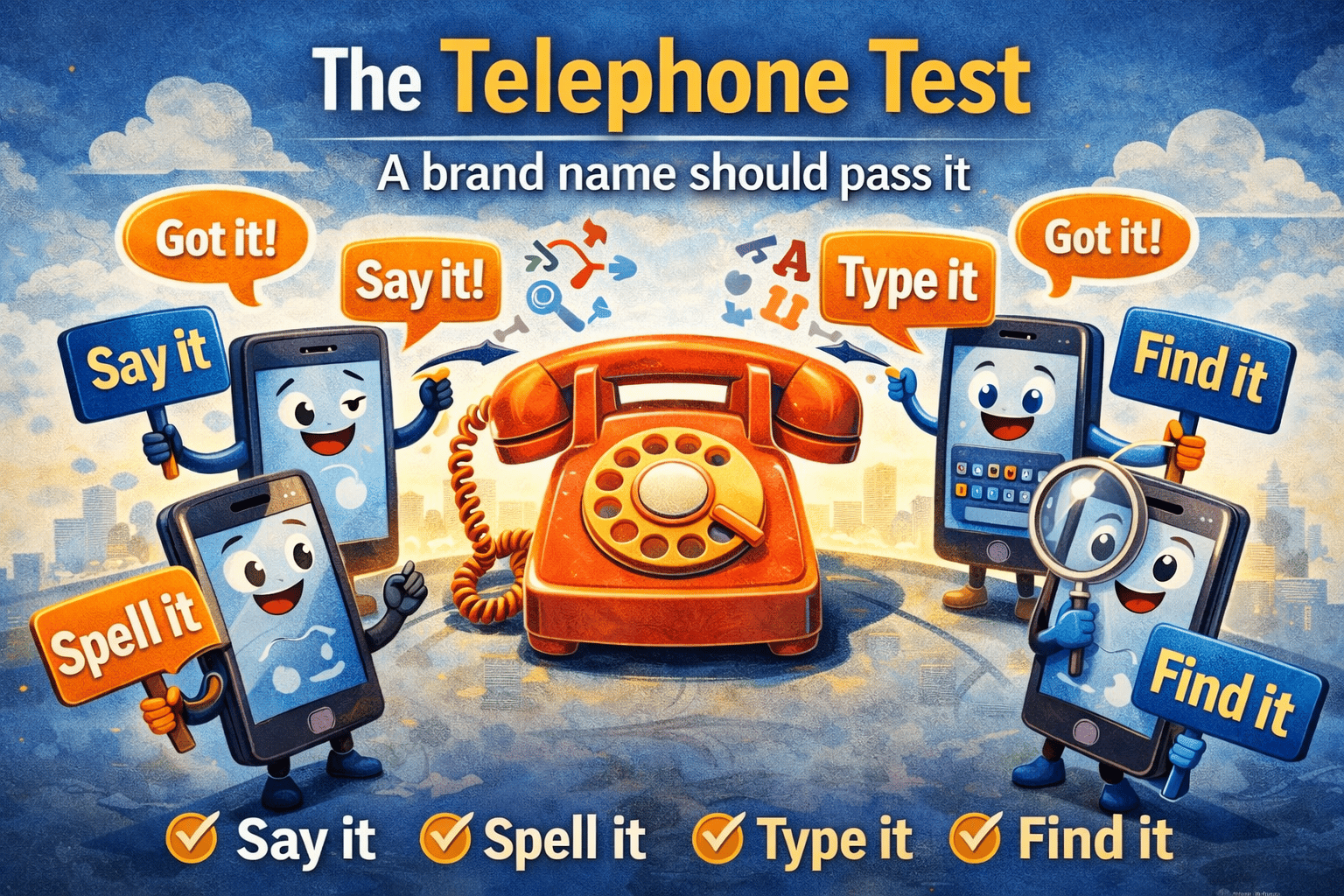
The Telephone Test
There’s also one practical rule I always come back to.
A good name should pass the telephone test. At least, that’s what my very good internet entrepreneur friend told me in college.
If someone hears the name once, they should be able to:
Say it.
Spell it.
Type it.
Find it.
That means:
Short, simple, and clear names win.
Complex names lose.
The Naming Strategy Most People Should Follow
If you’re building a personal brand or a founder-led company, the most logical path usually looks like this:
Step 1 — Start with your name
This builds trust.
Step 2 — Build media
Podcast
Newsletter
Content
These build audience.
Step 3 — Develop frameworks
Ideas that represent your thinking.
These build authority.
Step 4 — Launch products
Tools, services, or companies.
These build revenue.
Step 5 — Build an umbrella brand
Eventually you may create a higher-level brand that holds everything together.
This becomes your long-term platform.
The Takeaway
Most people pick names like they’re labeling a product.
But the best names don’t label products.
They support careers (and global companies).
They create a place where your work can grow and where new ideas can live.
A place where the next chapter of your work doesn’t require starting over.
If you design your brand architecture the right way, the name you choose today won’t trap you tomorrow.
It will give you room to build the things you haven’t even imagined yet.
And that’s the real goal of a great brand name.
Not to describe what you do today.
But to support everything you’ll build next.

1) Yes, it’s my 33rd birthday today. My one ask is that you send this newsletter to someone you think would like it and ask them to subscribe.
2) If you liked this article, the next article you should read is The Brand System
Reply